
Forjinn AI Builder Overview - Chat Builder and Visual Canvas
Complete overview of Forjinn's dual-mode AI builder. Use Chat Builder for conversational AI setup or Visual Canvas for drag-and-drop node-based workflow creation. Explore the tile-based dashboard with Development Tools, Security, and Settings.
Forjinn AI Builder Overview
Forjinn provides two powerful ways to build AI workflows, each designed for different use cases and skill levels. Choose the interface that best fits how you work.
Two Builder Modes
Chat Builder — Conversational AI Setup
The Chat Builder is recommended for most users. It's a conversational AI interface where you describe what you want to build using natural language, and the AI guides you through the entire setup process.
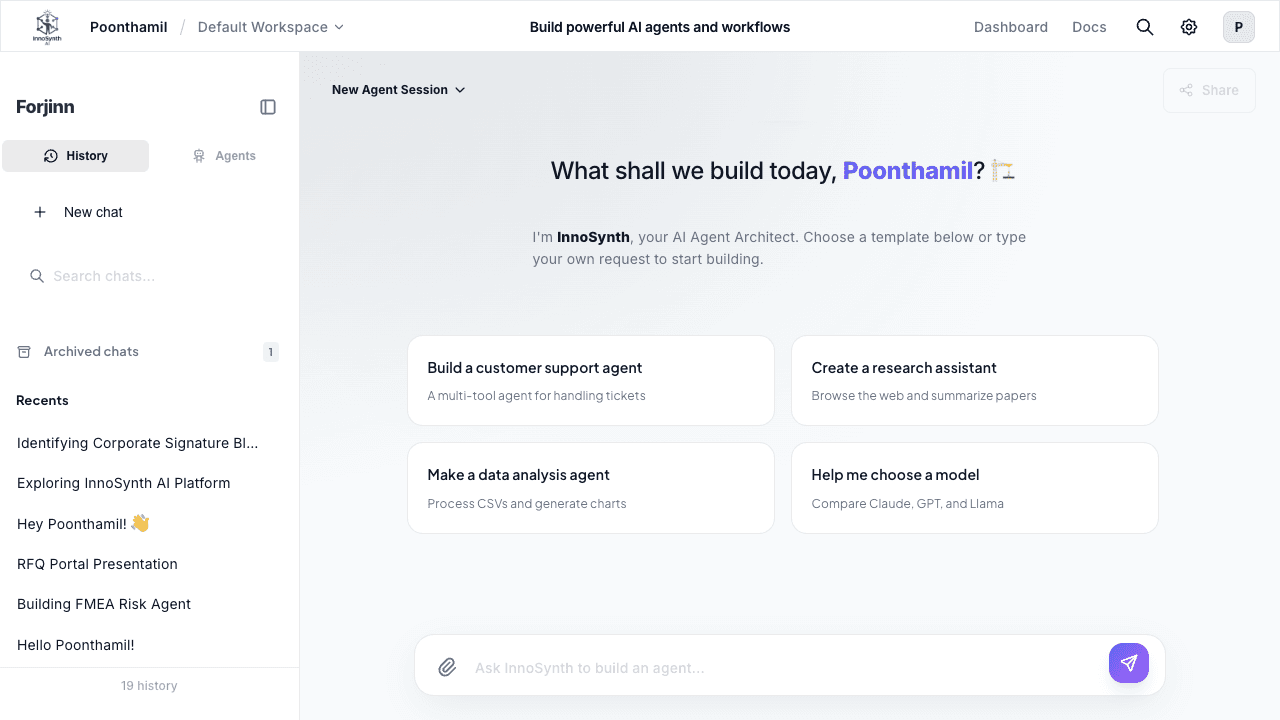
When you open the Chat Builder, you'll see the greeting: "What shall we build today? I'm InnoSynth, your AI Agent Architect." Simply type a description of what you'd like to create, and the AI will walk you through configuration step by step.
Key Features
- Conversational AI Guide: Describe your workflow in plain English and the AI translates your intent into a working configuration.
- Smart Template Suggestions: Get instant recommendations based on your input, including templates for customer support agents, research assistants, data analysis agents, and model comparison tools.
- Guided Step-by-Step Setup: Follow an interactive flow that walks through configuration choices, tool selection, and parameter tuning.
- Real-Time Chat Preview: Test your agent as you build it with a live chat preview panel.
Best For
- Ideation and exploration of AI agent concepts
- Rapid prototyping without technical overhead
- Users new to AI workflow development
- Guided configuration with expert suggestions
Visual Canvas — Node-Based Drag-and-Drop
The Visual Canvas is a traditional drag-and-drop, node-based interface for building complex AI workflows. It provides full visual control over every aspect of your agent configuration.
Key Features
- Low-Code Node Editor: Drag and drop pre-built nodes from a component library onto the canvas.
- Complex Logic Branching: Create multi-path workflows with conditional logic, loops, and branches.
- Advanced Variable Mapping: Pass data between nodes using a visual connection system.
- Full Control Over Flow: Fine-tune every parameter and connection for maximum flexibility.
Best For
- Advanced users who need granular control
- Complex multi-step workflows with branching logic
- Teams that prefer visual, node-based development
- Integration of multiple AI tools and frameworks
The Dashboard
After choosing your builder mode, you access the main dashboard at /app/visual. The dashboard uses a modern tile-based layout with modules organized into four categories.
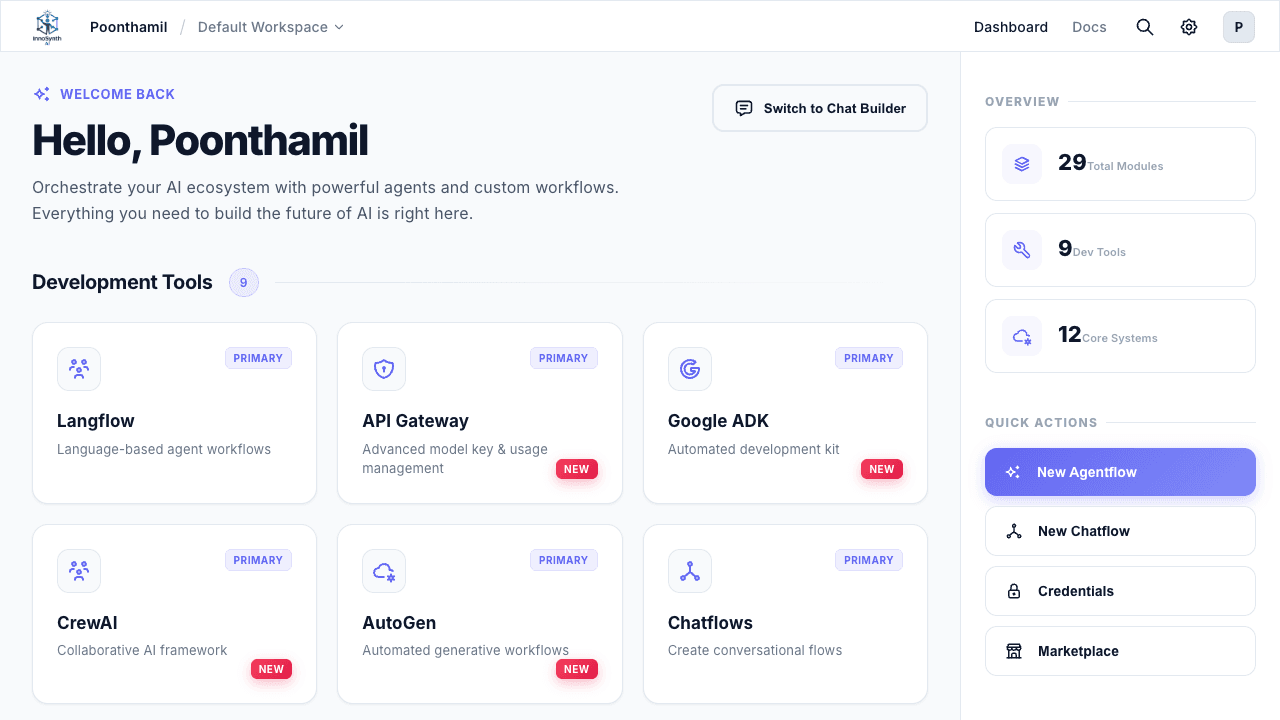
Development Tools (9 modules)
This section contains the AI building frameworks and tools available on the platform. Each tile shows its current status:
- Langflow (Primary) — Visual workflow builder for LangChain applications
- API Gateway (New) — Centralized API routing and management
- Google ADK (New) — Google AI Developer Kit integration
- CrewAI (New) — Multi-agent orchestration framework
- AutoGen (New) — Microsoft's customizable agent framework
- Chatflows (Primary) — Visual chat workflow builder
- MetaGPT (Upcoming) — Multi-agent software engineering framework
- CAMEL (Upcoming) — Communicative agent machine learning framework
- SmolAgents (Upcoming) — Lightweight agent library
Module status indicators:
- Primary — Fully available and stable
- New — Recently added, fully functional
- Upcoming — Coming soon, not yet available
User Management (5 modules)
Administrative tools for managing platform users and access:
- Cloud Admin — Central administration panel
- Users — User account management
- Roles — Role-based access control
- Workspaces — Workspace and team management
- Login Activity — Sign-in logs and activity monitoring
Security (3 modules)
Tools for managing credentials and access security:
- Credentials — API key and secret management
- API Keys — Platform-specific key generation and revocation
- SSO Config — Enterprise single sign-on configuration
Settings (12 modules)
Platform configuration and management tools:
- Executions — Workflow execution history and monitoring
- Assistants — AI assistant configuration
- Marketplaces — Template and component marketplace
- Tools — Custom tool integration
- Triggers — Event-based workflow automation
- Variables — Global and workflow-level variable management
- Document Stores — Document and knowledge base storage
- Logs — System and execution logging
- Account Settings — User profile and preferences
- Datasets — Data management for training and evaluation
- Evaluators — AI output evaluation configuration
- Evaluations — Evaluation results and analytics
Right Sidebar
The dashboard sidebar provides three quick-access panels:
Overview Stats
Key platform metrics at a glance:
- 29 Total Modules — All available tools and settings
- 9 Dev Tools — AI development frameworks
- 12 Core Systems — Platform settings and management modules
Quick Actions
One-click shortcuts to common tasks:
- New Agentflow — Create a new agent workflow
- New Chatflow — Create a new chat workflow
- Credentials — Manage API keys and secrets
- Marketplace — Browse pre-built templates
Recent Activity
A chronological list of your most recent flows, showing workflow names and timestamps for quick access to your latest work.
Top Navigation Bar
The top bar spans the width of the dashboard and provides:
- Forjinn Logo — Links back to the platform home
- Workspace Name — Shows the currently active workspace
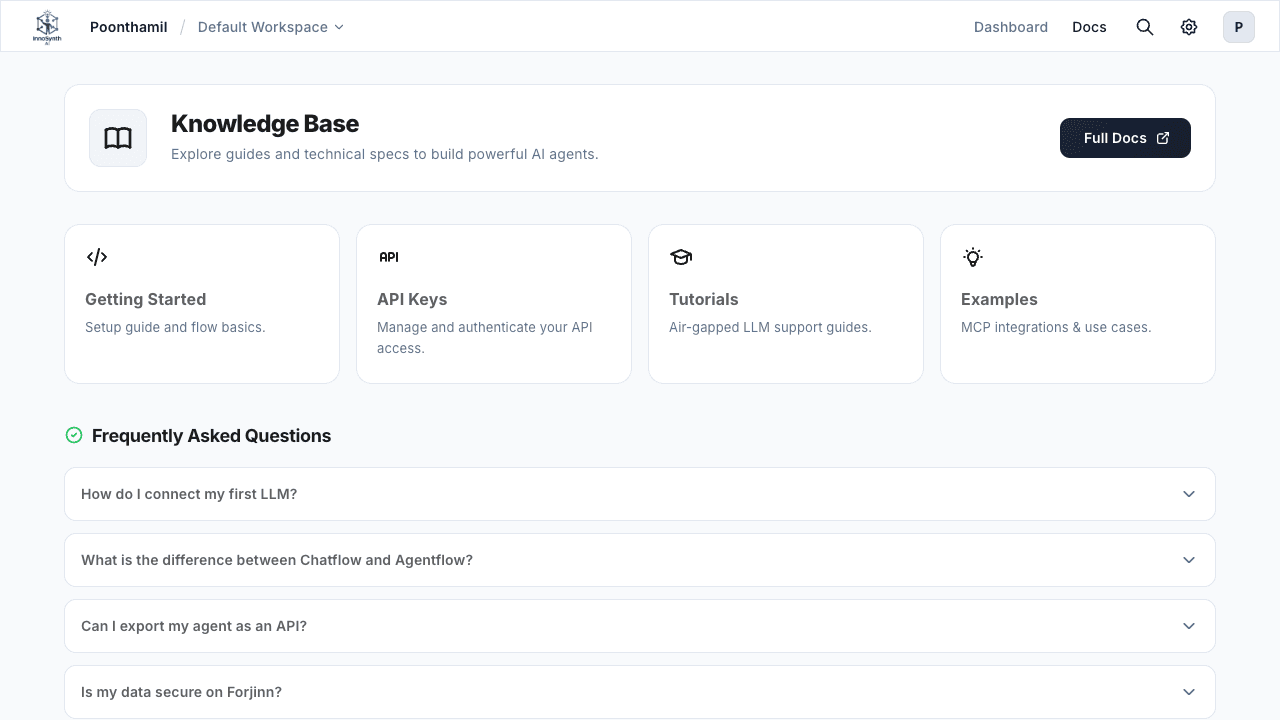
- Dashboard / Docs Tabs — Switch between the tile-based dashboard view and the integrated documentation panel
- Search Apps — Quick search across all modules and tools
- Settings Gear — Fast access to account and platform settings
- User Profile — Account menu with sign-out option
Switching Between Views
Dashboard to Chat Builder
On the dashboard's welcome area, click "Switch to Chat Builder" to return to the conversational AI builder mode. This button sits in the top right of the welcome section, making it easy to toggle between the tile-based dashboard and the guided Chat Builder.
Dashboard to Docs
Use the Dashboard / Docs tab switcher in the top navigation bar to toggle between the main dashboard tiles and the integrated documentation view. The Docs tab provides access to platform guides, API references, and tutorials without leaving the application.
Which Mode Should You Choose?
| Need | Recommended Mode |
|---|---|
| Quick prototyping and ideation | Chat Builder |
| Natural language configuration | Chat Builder |
| Step-by-step guided setup | Chat Builder |
| Complex branching logic | Visual Canvas |
| Fine-grained node control | Visual Canvas |
| Multi-tool integration | Visual Canvas |
Next Steps
- Quick Start Guide — Get up and running in minutes
- Logging In — Account creation and sign-in options
- Dashboard Overview — Detailed dashboard navigation guide
- Creating Your First Agent — Step-by-step agent creation
- Marketplace — Browse and import templates
Logging In to Forjinn - Sign In, Sign Up, and SSO
Learn how to log in to InnoSynth-Forjinn. Sign in with email, phone, OTP, or enterprise SSO. Create a new account and access the AI agent builder platform.
Forjinn Dashboard Overview - Tile-Based Module Navigation
Complete guide to the Forjinn dashboard. Navigate Development Tools, User Management, Security, and Settings tiles. Use Quick Actions, Overview stats, and Recent Activity in the sidebar.