
Adding Credentials to Forjinn | API Keys & Authentication Setup
Learn how to securely add and manage API keys and credentials in Forjinn Visual AI Agent Builder. Connect to OpenAI, Anthropic, Google, and other AI services safely.
Adding Credentials
Credentials are essential for connecting Forjinn to external AI models, tools, and services. This guide explains how to securely add and configure your API keys and authentication details.
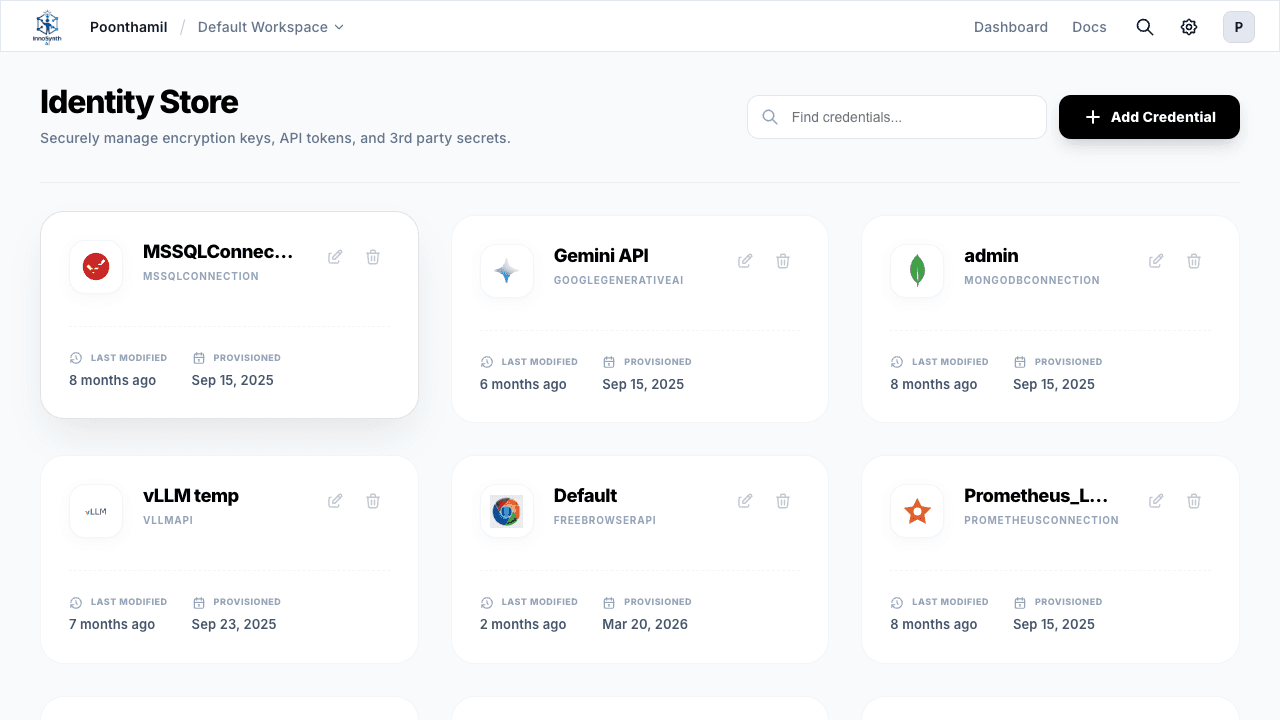
What are Credentials?
Credentials are sensitive pieces of information (like API keys, access tokens, or usernames/passwords) that allow Forjinn to authenticate with third-party services on your behalf. By centralizing credential management, Forjinn helps you keep your sensitive data secure and easily reusable across multiple flows and agents.
Accessing the Credentials Page
- Navigate to Credentials: From the dashboard, go to
/credentialsor click on "Credentials" under the Security section in the main navigation. - You will see a clean list/table view of all your saved credentials, with options to search, filter, and manage them.
Adding a New Credential
-
Click "Add New": On the credentials page, click the "Add New" button to create a new credential.
-
Choose Credential Type: A dialog will appear, prompting you to select the type of credential you want to add. Forjinn supports a wide range of providers. Available credential types include:
- OpenAI API Key: For connecting to OpenAI models (GPT-4, GPT-3.5, etc.)
- Anthropic API Key: For connecting to Anthropic Claude models
- Google Generative AI: For connecting to Google Gemini models
- AWS Bedrock: For accessing AI models through Amazon Bedrock
- Azure OpenAI: For connecting to Azure-hosted OpenAI models
- Groq API Key: For high-inference-speed model access
- HuggingFace Token: For accessing the HuggingFace model hub
- Google Search API Key: For using Google Search as a tool
- Serper API Key: For web search capabilities
- Wolfram Alpha AppID: For computational knowledge engine access
- HTTP Basic Auth: For services requiring a username and password
- HTTP Bearer Token: For services requiring a bearer token
- Custom/Generic API Key: For other services using a simple API key header
-
Fill in Details:
- Once you select a credential type, a provider-specific form will appear with the required fields.
- Name: Give your credential a descriptive name (e.g., "Production OpenAI Key," "Dev Claude API," "Project X Google Search").
- API Key/Token/Secret: Carefully paste or type the actual sensitive value (e.g., your OpenAI API key). Ensure there are no leading or trailing spaces.
- Other Fields: Depending on the credential type, you may need to provide additional information such as:
- Base URL / Endpoint: For custom API endpoints or self-hosted models
- Organization ID: For OpenAI or Anthropic organization-scoped keys
- Region: For AWS Bedrock or Azure OpenAI deployments
- Client ID / Client Secret: For OAuth2-based integrations
- Scopes: For OAuth2 permission grants
-
Save Credential: Click the "Save" or "Create" button to securely store your new credential. You will be returned to the credentials list, where your new entry will appear.
Security Best Practices
- Never Share API Keys Publicly: Treat your API keys like passwords. Do not hardcode them in public repositories or expose them in client-side code.
- Use Environment Variables: If you are developing locally, use environment variables to store your keys.
- Least Privilege: Only grant the necessary permissions to the API keys you use.
- Rotate Keys: Regularly rotate your API keys, especially if you suspect they might have been compromised.
- Track Dependencies: Before deleting or modifying a credential, check the credentials page to see which flows are currently using it. This helps avoid unexpected breakages.
Once added, your credentials will be available for selection when configuring LLM nodes, tool components, or other integrations within your flows and agents.